
Activities
Fun activities like Gyotaku, Scrimshaw, Whale Origami, Abalone Races, and numerous live performances by local bands and orchestras will be featured on both April 12th and 13th on Old Fisherman’s Wharf. Local historian Tim Thomas will also conduct his very informative historical Wharf Walks.
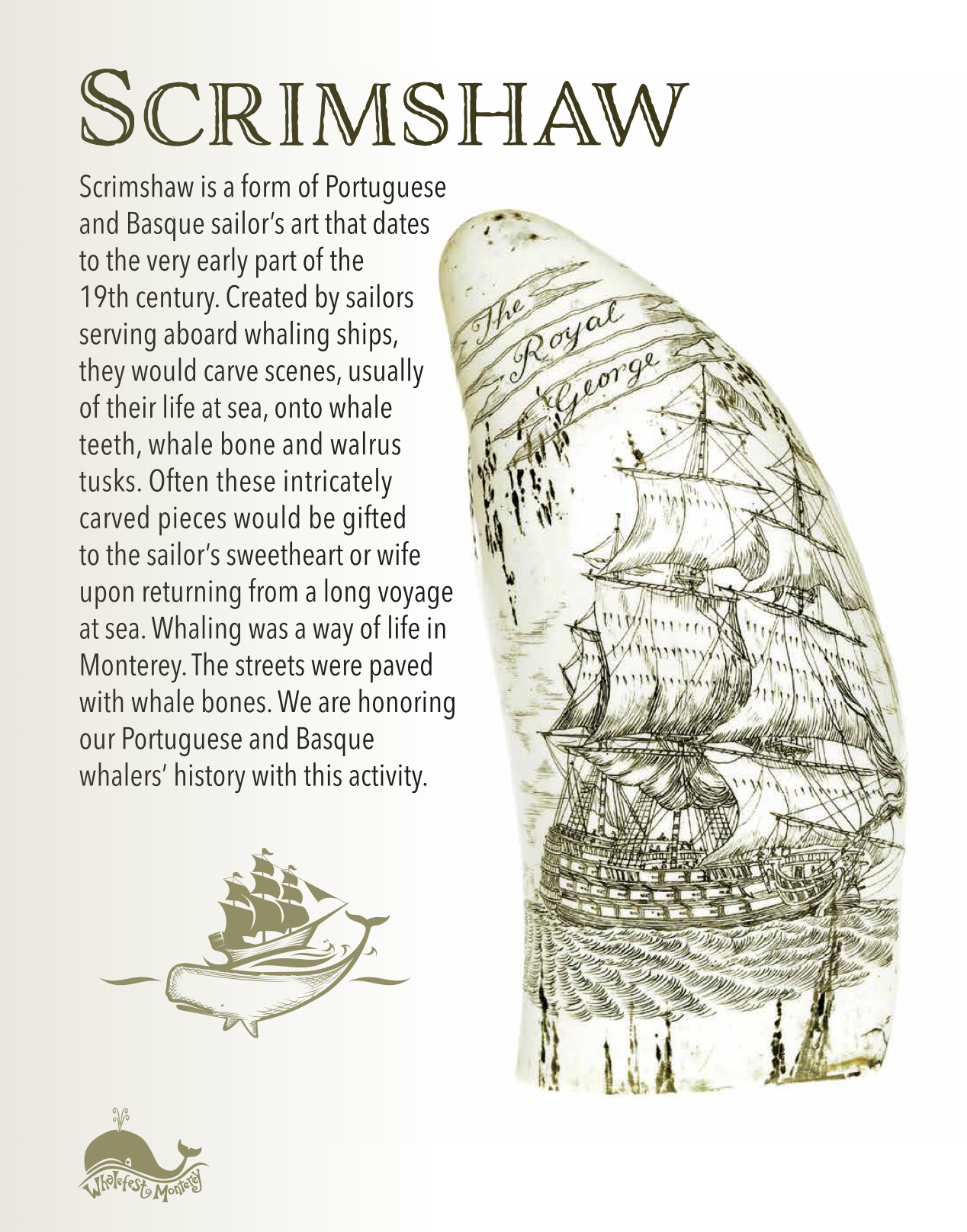


Scrimshaw is a form of Portuguese and Basque sailor’s art that dates to the very early part of the 19 th century. Created by sailors serving aboard whaling ships, they would carve scenes, usually of their life at sea, onto whale teeth, whale bone and walrus tusks. Often these intricately carved pieces would be gifted to the sailor’s sweetheart or wife upon returning from a long voyage at sea. Whaling was a way of life in Monterey. The streets were paved with whale bones. We are honoring our Portuguese and Basque whalers' history with this activity.
Gyotaku was a way for Japanese fishermen to remember their catch. This art form dates to the mid-19th century before everyone had a camera. It was really used to document “trophy catches” or anything big or unusual. After printing the fish, the fisherman would wash off the ink so it would be presentable to sell at the market. These early fish prints were not considered to be an art form but rather as a way to record their catch. Prior to World War II, most of the businesses on Fisherman's Wharf were owned by Japanese. We are honoring our Japanese history with this activity.
Origami is believed that the art of origami was invented by the Japanese over a thousand years ago and is an art form as old as paper itself! There are different styles of origami, ceremonial, girei (formal folded ornaments) and recreational. Perhaps the most famous use of origami was told in the classic book, “Sadako and the Thousand Paper Cranes” by Eleanor Coerr. The Monterey Japanese community first arrived before the turn of the 20th century, and it was fishing that brought them here, abalone and salmon. It can be said that abalone built the Monterey Wharf, prior to WWII, most of the business on the Wharf were owned and operated by Japanese, fish markets and abalone processors.

Cooking demonstration by Chef Tene Shake
-
Chef Tene Shake is part of the Iconic Shake family, which has been in Monterey for generations and has played an integral role in the rich history and success of Fisherman’s Wharf. He is an award-winning chef as well as a respected realtor and owner of Tene Shake Properties. The Shake family legacy lives on today, operating several restaurants, fish markets, and boats. Tene is the youngest of five brothers, thus earning him the nickname “Tene.” He was fascinated by seafood from a young age and learned as much as he could from his brothers and the family restaurant, the iconic “Old Fisherman’s Grotto” and his father, legendary chef/restaurateur, Sabu Shake. At age eleven, Tene continued his training, working as a cook at the Cove Restaurant for the Crivello Family. As a teenager, Tene managed his family fish market business and delivered seafood to the local restaurants. Tene graduated from Bethany University with a Bachelor of Arts degree in 1988. Following college, he completed levels 1-3 at the California Culinary Academy & attended classes Le Cordon Bleu and the International Culinary Center/French Culinary Institute. In 2009, Tene had the honor of spending time at the White house with chef Sam Kass and doing a little harvesting in the White House Organic Garden. Chef was voted 2014 Chef of the Year and was Chairman of Les Toque Blanches International- Monterey and the American Culinary Federation (ACF), Central Coast and President of the National Chapter of ACF Central Coast. In 2009, Tene built a hospitality company with over 350 employees, and was the Co-creator & Co-founder of LiveTraxs Digital Events, a music tech company.
Born and raised on the Monterey Peninsula, Tene Shake is the authentic “Local Real Estate Expert” with “Local Knowledge” of real estate on the Monterey Peninsula. Growing up in Monterey and Carmel Valley, he attended local schools and had the privilege of living in luxury estates as well as often visiting his brother’s homes in Pebble Beach, including one located on the famous 17-mile drive. Tene has a passion for real estate, buying his first home at age 19. While navigating through complex commercial real estate deals, Tene has been involved in over $50 million of real estate acquisitions. Tene follows in the tradition of giving back instilled in him as a young man by his Mom & Dad that simply taught him “you receive in order to give”. When Tene is not working with real estate, he can be found managing the Grotto Fish Market/Kokomo’s on Old Fisherman's Wharf.
Tene is proud to support over 300 charities and organizations including Salvation Army Monterey Peninsula Corps, Monterey County School Districts, Meals on wheels, Rancho Cielo, Boys & Girls clubs Monterey, SPCA, Cooking for solutions, Mission Acts, Dorothy’s Kitchen, CASA Monterey, and feeding the homeless. One of Tene’s most humbling experiences was meeting Mother Teresa in Calcutta, India in 1991 and spending a half day with her visiting the areas of the poor and homeless she visited often.Tene has done cooking demos for both Whalefest Monterey, Festa Italia and at other events, as well.
Tene lives in Monterey County with his wife, Tracy. January 2025 marks the celebration of their 43rd wedding anniversary.
The “Almost Famous” Abalone Races is brought to you by the Monterey Abalone Company. Who would have thought such a thing existed? This quirky event, held at the end of the wharf, always draws a crowd of spectators, young and old alike.
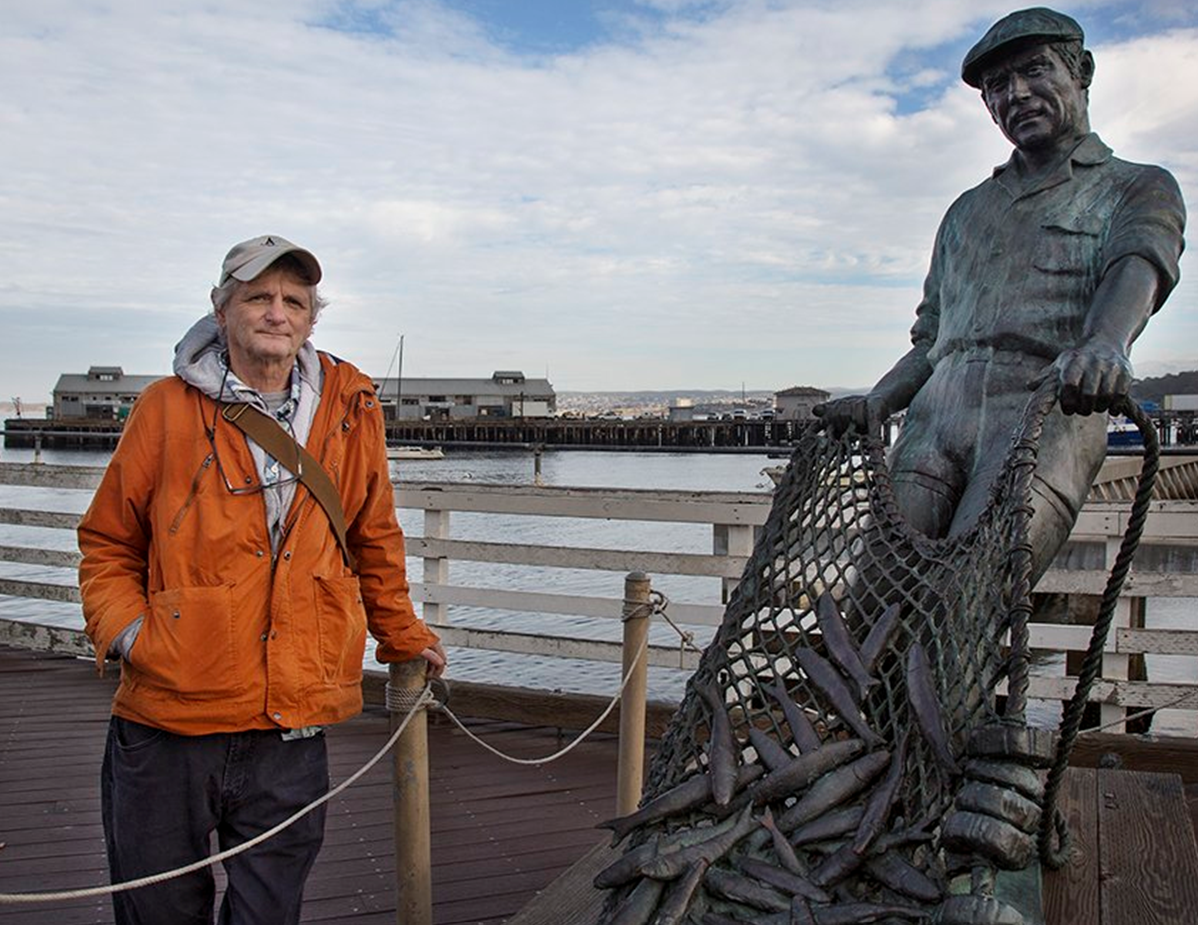

Wharf History Walks with Historian Tim Thomas
Tim Thomas is a fisheries historian and author who has researched the fisheries and cultural history of Monterey for over forty years. For sixteen years he was the Historian/Curator for the Monterey Maritime Museum. Tim is the co-author of Monterey’s Waterfront, author of the Japanese on the Monterey Peninsula, and author of The Abalone King of Monterey: “Pop” Ernest Doelter, Pioneering Japanese Fishermen & The Culinary Classic that Saved an Industry and co-author of Diving Abalone along the California Coast
Tim has been a historical consultant for the Monterey Bay Aquarium and has worked and developed programs for Monterey Bay National Marine Sanctuary and California State Parks. Tim has been featured on PBS, BBC and on C-span
In 2023, The Monterey Bay National Marine Sanctuary awarded Tim the Ed Ricketts Memorial Award for Lifetime Achievement in the Field of Historical Ecology
He is on the board of directors of the Monterey Japanese American Citizens League and curator of Japanese American Heritage Center. He has traveled and lectured extensively on the Monterey Japanese community both in the United States and in Japan.
Painting Demonstration by Artist Murray Wagnon
Murray will paint the Whale Watching Boat Building, after which you may join in, find your composition and paint.